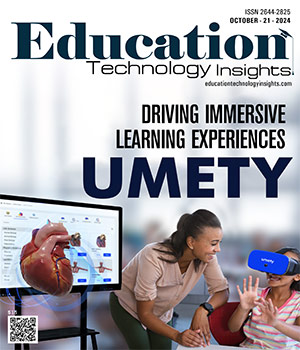

Umety: Driving Immersive Learning Experiences

Top 10 AI Powered Education Tech Providers – 2024

AI powered education technology is revolutionizing the way we learn, making classrooms more interactive, personalized, and efficient. From smart tutoring systems to adaptive learning platforms, education tech providers are harnessing the power of AI to transform teaching and learning experiences.

Reports state that the global AI powered education tech providers market, valued at $1.82 billion in 2021, is estimated to grow to $32.27 billion by 2030 at a CAGR of 36.0 percent.

A wave of tech developments is fueling this growth. Personalized learning is becoming the norm, with AI-driven systems adapting content to each student's needs. The shift to remote and hybrid education has also spiked demand for scalable, flexible tools. Advancements in natural language processing and AI-powered tutors are enhancing student support while increasing investments in the sector are driving innovation, aiming to improve outcomes and prepare students for future challenges.

This edition of Education Technology Insights brings recent developments in the AI-powered education technology arena and insights into how these innovations are reshaping the learning landscape.

It features thought leadership articles from industry experts, including David Bourgeois, director of artificial intelligence lab at Biola University, who discusses the transformative impact of artificial intelligence (AI) on education, emphasizing the need for thoughtful integration rather than resistance. Don Ringelestein, executive director of technology at Yorkville CUSD #115, delves into the importance of cybersecurity for educational technology leaders and the need for districts to prioritize their cybersecurity investments effectively.

We hope this edition featuring the Top AI Powered Education Tech Providers of 2024 helps you find the best-suited partner to navigate the evolving landscape of educational technology.

Let us know your thoughts!  

    Top AI Powered Education Tech Providers

  • StudyFetch is an AI-powered platform designed to enhance learning by transforming course materials into interactive study tools. Aiming to elevate student academic performance and provide professors with advanced teaching methods, the company delivers an innovative AI-native learning platform.

    www.studyfetch.com

  • CYPHER

    CYPHER

    CYPHER provides a comprehensive AI-driven learning platform focused on ease of use and effectiveness. It streamlines course creation, enhances personalized learning, and boosts training results. With its intuitive design, CYPHER helps educators deliver better teaching and enables learners to thrive, always putting people first.

  • Element451

    Element451

    Element451 is an AI-powered CRM and student engagement platform transforming how institutions connect with students. Through AI-driven packages, including chatbots and copilot assistants, it enables hyper-personalized communication, revolutionizing student engagement, marketing, and success at every stage of their educational journey.

  • ELSA

    ELSA

    ELSA is an AI-powered English-speaking app designed to help learners improve pronunciation and communication skills. Founded in 2015, it has over 50 million downloads globally and offers personalized learning experiences with speech recognition technology. ELSA aims to empower people to speak English confidently across various contexts.

  • ExamRoom.AI

    ExamRoom.AI

    ExamRoom.AI provides a web-based, remote proctoring solution focused on secure, scalable online assessments. With AI-powered monitoring and human-verified proctoring, it ensures exam integrity and seamless integration with learning management systems. ExamRoom.AI supports live, recorded, and AI-driven proctoring for institutions, businesses, and certification bodies globally.

  • igebra.ai

    igebra.ai

    igebra.ai is a US-based company focused on Data & AI research, development, and education, with a passion for empowering children. Leveraging 25+ years of experience, it combines "math + data + AI thinking" with coding and its "I5 SMart Learning" methodology to inspire creative problem-solving in kids.

  • Lanes

    Lanes

    Lanes is a virtual classroom platform that empowers L&D teams to deliver engaging training at scale across organizations. It offers interactive tools like polls, quizzes, breakout discussions, role-playing games, whiteboards, and more, enhancing virtual learning experiences and facilitating collaboration on complex tasks like business negotiations and problem-solving.

  • Magic EdTech

    Magic EdTech

    Magic EdTech is dedicated to making digital learning accessible, immersive, and effective. Partnering with educational organizations, they help build, support, and deliver digital learning products and platforms. By focusing on accessibility and innovative solutions, Magic EdTech assists customers in overcoming challenges and achieving their educational goals.

  • PowerSchool

    PowerSchool

    Sibme’s AI-enhanced professional learning platform supports self-reflection, virtual coaching, peer collaboration, and micro-credentials. Serving over 1,000 schools and institutions like Scholastic and the University of Texas, Sibme is designed by teachers to foster meaningful professional development through cohort-based communities and hybrid learning models.

  • Sibme

    Sibme

    Sibme’s AI-enhanced professional learning platform supports self-reflection, virtual coaching, peer collaboration, and micro-credentials. Serving over 1,000 schools and institutions like Scholastic and the University of Texas, Sibme is designed by teachers to foster meaningful professional development through cohort-based communities and hybrid learning models.

Artificial Intelligence FAQ

Q1
What Do Top AI-Based Education Solutions Help Schools and Institutions Do?
Top AI-Based Education Solutions are designed to support teaching, learning and academic administration through intelligent software, automation and personalized learning tools. Many platforms help educators adapt lessons to different learning levels, automate grading tasks and identify learning gaps earlier. Universities and training providers also use AI to improve student support, course recommendations and engagement tracking. The value often comes from reducing repetitive work while giving educators clearer visibility into student progress. Most schools already have digital tools. The challenge is whether those systems actually help teachers make faster instructional decisions.
Q2
Why Is Demand for Top AI-Based Education Solutions Growing?
Demand continues to grow because educational institutions face pressure to deliver more personalized learning while managing larger volumes of data, digital content and student support needs. AI tools can help address these challenges by adapting learning pathways, providing intelligent tutoring and automating routine administrative work. The AI in education market is expanding rapidly as schools, universities and training organizations invest in digital learning infrastructure and scalable student support models. Growth is also being driven by hybrid learning environments and rising expectations around individualized education experiences.
Q3
How Should Educational Leaders Evaluate AI-Based Education Providers?
Educational leaders should look beyond product demonstrations and examine how the system performs in real classroom or institutional conditions. A useful evaluation often includes testing the platform with actual course materials, reviewing how recommendations are generated and understanding what data is required to support personalization. Data privacy, educator control and implementation support also matter. A platform may produce impressive outputs during a demonstration but create adoption problems if teachers cannot easily adjust content, review recommendations or understand how decisions are being made.
Q4
What Value Do Top AI-Based Education Solutions Deliver for Students and Educators?
The strongest solutions help create more responsive learning environments rather than simply adding another software layer. Students can receive learning content aligned with their pace, performance and areas of difficulty. Educators gain more time for mentoring, instruction and classroom interaction because repetitive tasks can be automated. Personalized feedback is often one of the most practical benefits. A student struggling with a concept may receive targeted support earlier instead of waiting until a formal assessment reveals the problem.
Q5
How Are AI Technologies Changing Modern Education Platforms?
Many providers now combine machine learning, natural language processing and generative AI capabilities within broader education platforms. These technologies support intelligent tutoring, adaptive assessments, automated content creation and conversational learning experiences. Newer systems can analyze student interactions and adjust recommendations in real time. At the same time, institutions are paying closer attention to transparency, bias, academic integrity and responsible AI use. Educational technology decisions increasingly involve both learning outcomes and governance considerations. A helpful recommendation is valuable only if educators can trust how it was generated.
Q6
What Should Decision-Makers Prioritize When Comparing Top AI-Based Education Solutions?
Decision-makers should focus on educational fit rather than the number of features a platform claims to offer. Integration with existing learning systems, ease of adoption, instructor oversight, accessibility support, and measurable learning outcomes often have a greater impact than an extensive list of AI capabilities. Institutions should also evaluate vendor support, implementation timelines, and long-term scalability. A platform that works well for a pilot group may not be as effective when expanded across multiple departments or campuses. The most effective Top AI-Based Education Solutions combine personalization, practical usability, and responsible data practices while making the experience easier for educators and learners.